
Many business owners have met the Business Model Canvas in a training course or a start-up class and come away with a nine-block sheet. When they sit down to fill it in, they are not sure which block to start with, how detailed each one should be, or what to do with it afterwards. So many write it once and file it away.
This guide shows how to fill in the Canvas block by block in an order that works in practice. It uses a hypothetical coffee shop in Khon Kaen as a full worked example, and adds something general articles rarely cover: the legal question hidden in each block. Every time you write "members collect points" or "we sell packed coffee beans" in one block, a document, a licence or a contract follows.
The core answer
A Business Model Canvas is a one-page, 9-block table that describes who the business creates value for, how it delivers that value, and how it earns money in return. Start with Customer Segments and Value Propositions. Then fill in the right-hand side (Channels, Customer Relationships, Revenue Streams), and then the left-hand side (Key Resources, Key Activities, Key Partnerships, Cost Structure). Write short, one idea per sticky note, and check that every block connects to the others.
The rule (Thai law). A Canvas is not a contract and needs no registration, but what you write in each block is regulated. For example, collecting member data requires you to tell people the purpose, who will receive the data, how long it will be kept and the data subject's rights, before or at the time of collection, under the Personal Data Protection Act B.E. 2562 (2019) section 23. A lease of immovable property for more than 3 years must be in writing and registered with the competent official, otherwise it is enforceable in court for only 3 years, under the Civil and Commercial Code section 538. And where an employee creates a work as an employee, copyright belongs to the employee who created it unless the parties have agreed otherwise in writing, although the employer may publish the work for the purpose of the employment, under the Copyright Act B.E. 2537 (1994) section 9.
Our practical view. Fill in the Canvas twice. The first pass is for the business: get a complete picture in which the blocks fit together. In the second pass, read it block by block and ask: "What contract, licence, tax or disclosure does this block need, and in whose name will it stand?" The answers form the list of legal tasks before opening, which is much easier to handle now than to fix after the shop has opened.
For an overview of how each business model changes your contracts, tax and licences, see the business model guide for Thai SMEs. This guide focuses on how to write the Canvas and put it to use.
1. What a Business Model Canvas is and what it is for
The Business Model Canvas was developed by Alexander Osterwalder and published in the book Business Model Generation, which he wrote with Yves Pigneur. The version of the Canvas sheet in common use was designed by Strategyzer AG and is published under a Creative Commons Attribution-ShareAlike licence (CC BY-SA 3.0). A business can therefore print it for internal use, as long as it keeps the credit and the licence terms.
The core idea is that any business model can be described in 9 questions: who the customers are, what we offer, which route reaches the customer, how we look after the customer, what we earn from, what we must have, what we must do, who helps, and where the costs come from. When all 9 sit on one sheet, everyone on the team sees the same picture.
What you can use it for
- Thinking through a new business. Before you rent premises or buy equipment, use the Canvas to check whether the idea covers every side.
- Explaining an existing business. Help partners, heirs or a new manager understand in the same way how the business makes money.
- Comparing options, such as adding delivery, selling online or opening a franchise, by drawing a separate Canvas for each.
- Finding weak points, such as reliance on a single supplier, a single platform, or everything being tied to the owner personally.
- Preparing to write a business plan. Each block can become a section of the plan (see section 10).
What a Canvas is not
A Canvas is not a financial projection, not an agreement between partners, and not proof that the idea works. In the early stages most of what you write is an assumption that still has to be proved. Cost and revenue figures belong in a separate projection prepared with an accountant.
2. The 9 blocks and the question each one asks
| Block | Main question | Examples of what to write |
|---|---|---|
| 1. Customer Segments | Who do we create value for, and which group matters most? | University students, office workers, retail shops in the province |
| 2. Value Propositions | What problem do we solve or what need do we meet for that group? | Same-day delivery, made to order, easy to use without training |
| 3. Channels | How do customers find us, buy, receive the product and get help? | Shopfront, website, marketplace, dealers |
| 4. Customer Relationships | How do we win new customers, keep existing ones and sell more? | Personal service, membership scheme, self-service, online community |
| 5. Revenue Streams | What do customers pay for, and how? | One-off sale, subscription, rental, pay per use, commission |
| 6. Key Resources | What do we need in order to deliver the value? | Premises, machinery, people, brand, recipes, data, capital |
| 7. Key Activities | What must we do regularly for the model to work? | Production, selling, servicing, building systems, quality control |
| 8. Key Partnerships | Who helps with what we do not do ourselves? | Suppliers, contract manufacturers, platforms, logistics companies |
| 9. Cost Structure | What are the main costs, and which block causes them? | Rent, wages, raw materials, platform fees |
The 9 blocks follow the Business Model Canvas of Strategyzer AG (strategyzer.com, licensed under CC BY-SA 3.0)
On the actual Canvas sheet, the right-hand blocks (Customer Segments, Channels, Customer Relationships, Revenue Streams) are about the market and earning money. The left-hand blocks (Key Partnerships, Key Activities, Key Resources, Cost Structure) are about how the work gets done and what it costs. Value Propositions sits in the middle and links the two sides. If the right-hand side answers "does anyone want to pay us?", the left-hand side answers "can we do it, and is it worth it?"
3. Where to start
A new business: start with the customer, then work from right to left
- Customer Segments. Be able to say who you are selling to first, because every other block refers to this one.
- Value Propositions. Write these separately for each customer segment. Different segments may want different things.
- Channels. Where does that segment buy this kind of thing?
- Customer Relationships. What kind of care do those customers expect?
- Revenue Streams. What do customers pay for, once or on a continuing basis?
- Key Resources. What do you need to deliver items 2 to 5?
- Key Activities. What must be done every day or every month?
- Key Partnerships. What should you not do yourself, and who can do it for you?
- Cost Structure. Summarise the costs that arise from items 6 to 8.
The reason for this order is that if you do not yet know who will pay and what for, any calculation of resources and costs on the left-hand side usually has to be thrown away and redone.
A business that is already open: write down what is true first
If the business is already open, do not start from what you want it to be. Write down what actually happens first, using sales reports, the customer list, existing contracts and real expenses. This version is your "current Canvas", the baseline against which you compare the "target Canvas" in section 9. Owners often find that most revenue comes from a customer group they never set out to serve, or that a large cost does nothing for the main customer group.
Other places to start
Business Model Generation explains that you can start thinking about a new business model from several points: from resources you already have (land, machinery, a recipe or a customer base), from a new offering, from a customer need, or from a new way of collecting money, such as switching from selling to renting. A family business that already owns land or a factory may therefore start with Key Resources. But wherever you start, you must always come back and answer Customer Segments and Value Propositions.
4. How to write it so that it is usable
Preparation and ground rules
- Use a large sheet and sticky notes. Print the Canvas large or draw it on a whiteboard. Write on sticky notes so they are easy to move and throw away. If you work online, use an online board in the same way.
- One note, one idea. Write short phrases, not long sentences or paragraphs.
- Be specific. "Students who sit and study in the shop for hours" works. "People in general" does not.
- Use colour to separate customer segments. If you have several segments, give each its own colour. Notes in other blocks that serve that segment use the same colour, and you can see at once which segment has no channel or revenue yet.
- Separate facts from assumptions. Mark the notes that are still guesses so you can test them later.
- Bring in the people who meet customers. Front-of-house staff or the sales team often know more about customers than the owner does.
- Date every version. Photograph or save each version every time you change it, so you can compare later.
How to write each block
Customer Segments. Separate segments when customers have different needs, buy through different channels or are willing to pay differently. A business that acts as an intermediary, such as a platform matching buyers with sellers, has customers on two sides. Write both, and be clear about who uses and who pays, for example the parent pays and the child uses, or the purchasing department pays and the staff use.
Value Propositions. Write from the customer's point of view, not as a list of product features. "Brewed on a new-model machine" is a feature. "Coffee that tastes the same every cup without a long wait" is value. Value can take many forms, such as newness, better quality, customisation, getting a job done, reducing risk, reducing the customer's costs or greater convenience. To go deeper, Strategyzer has a separate tool, the Value Proposition Canvas, which separates the customer's jobs, pains and gains and matches them to our product.
Channels. Think along the customer's journey: becoming aware of us, judging whether we are worth buying from, buying, receiving the product or service, and after-sales support. Then separate which channels are your own and which belong to partners, such as platforms or dealers. A partner's channel reaches customers widely, but you control it less.
Customer Relationships. Say what kind of care each customer segment expects, such as a dedicated person, self-service, automated service, a member community, or letting customers co-create content. State what the relationship is for: winning new customers, keeping existing ones or selling more.
Revenue Streams. Write these separately for each customer segment and say how customers pay, for example one-off sale, pay per use, subscription, rental, licence fee, commission or advertising. Do not put figures in the Canvas. Write only what customers pay for and how they pay, and leave the figures to the projection. The revenue form you choose affects contracts and tax. See selling, renting or charging per use.
Key Resources. Divide these into physical assets (premises, machinery, stock), intellectual property (brand, recipes, software, customer data), people and capital. Also write whether you own, rent or borrow each one, because this is where legal problems arise most often.
Key Activities. Write only what must be done well to keep the value proposition. For example, production, solving customer problems or running the platform. You do not need to list every job in the shop.
Key Partnerships. Say who you depend on and why: to cut costs, reduce risk or obtain resources you do not have. This includes suppliers, contract manufacturers, joint-venture partners and the platforms you sell through.
Cost Structure. Write the major costs and show whether they are fixed (rent, salaries) or vary with sales (raw materials, platform fees). Also say whether the business competes on low cost or on value that customers will pay extra for.
Test it by telling the story
When you have finished, read it aloud as one story, for example: "We help [customer segment] get [value] through [channels], look after them with [relationships], earn from [revenue], using [resources] to do [activities] together with [partners], and our main costs are [costs]." If the story does not flow, a block is missing or does not fit.
5. A full example: a coffee shop near a university in Khon Kaen
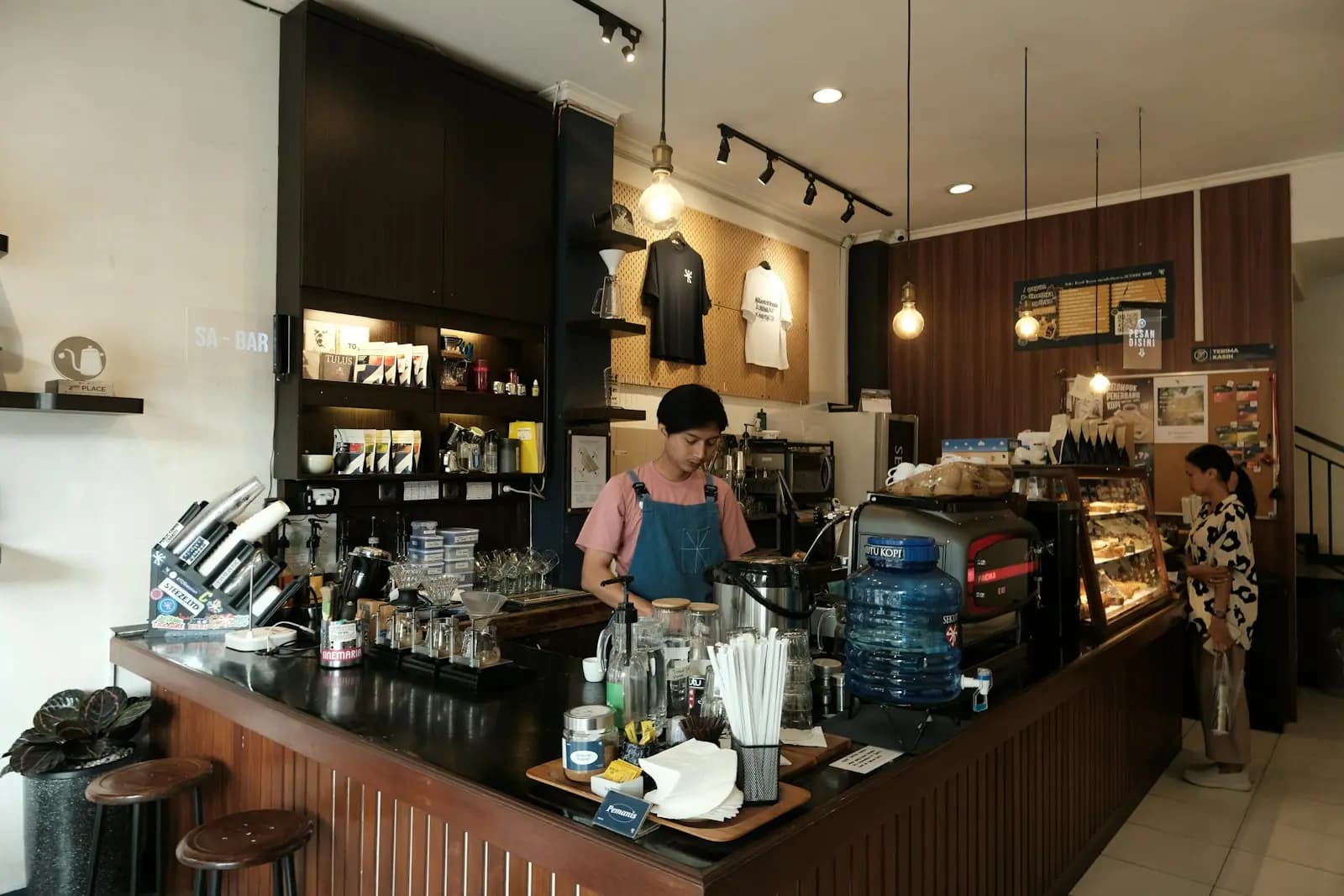
Suppose you open a small coffee shop in a rented shophouse near a university in Khon Kaen. You have 2 regular baristas and a part-time staff member in the evenings. You roast some beans yourself from Thai coffee beans. You sell through the shop, delivery apps and a LINE Official Account, and you are starting to think about selling packed roasted beans.
| Block | What the shop writes on its Canvas |
|---|---|
| Customer Segments | Students who sit and work or study in the shop; office workers in the area who buy to take away in the morning; delivery app customers within the delivery radius |
| Value Propositions | Coffee from Thai beans that the shop roasts itself, with a consistent taste; a place to work all day, with power sockets and Wi-Fi; order ahead on LINE and collect immediately |
| Channels | Shopfront; delivery apps; LINE Official Account; social media page; shop sign |
| Customer Relationships | Points membership card through LINE; baristas who recognise regulars; exam-period promotions |
| Revenue Streams | Drinks (main revenue); snacks and bakery items; packed roasted beans (new plan) |
| Key Resources | Rented shophouse; espresso machine and roaster; baristas; shop name and logo; drink recipes and roast profiles; member list |
| Key Activities | Roasting and quality control of beans; making drinks; cleaning the shop and equipment; creating content and answering chats |
| Key Partnerships | Green bean supplier; bakery that places snacks on consignment; delivery apps; espresso machine repairer |
| Cost Structure | Rent; wages and social security; coffee beans, milk and other ingredients; delivery app fees; electricity and equipment repairs |
The 9 blocks follow the Business Model Canvas of Strategyzer AG (strategyzer.com, licensed under CC BY-SA 3.0). This example is hypothetical.
Read as one story: this shop sells a place to work, together with consistent quality coffee, to students, and sells speed to working people who take their coffee away. It earns mainly from drinks, uses its own recipes and roasting as its point of difference, and depends on the green bean supplier and the delivery apps as key partners.
What this Canvas helps the shop see
- The value "a place to work all day" conflicts with revenue that comes from drinks sold by the cup. A customer who sits for hours but buys one cup takes up space without producing revenue. The shop may need a work-seat package, a drink-and-snack set, or a separate seating zone.
- Office workers do not need seats, they need speed. The LINE order-ahead channel therefore matters more to this group than the shop decor.
- The recipes and roast profiles are the shop's point of difference, but today they exist only in the baristas' heads. If a barista leaves, the value proposition may leave with them.
- Selling packed beans adds a revenue stream, a channel and a new activity at once, so it is not just "adding a product" but a separate small business of its own (see section 9).
6. Checking that the blocks fit together
A good Canvas is measured not by how many notes it has but by whether the notes connect. Work through these questions.
- Does every value proposition point to a particular customer segment? If nobody benefits, remove it.
- Does every customer segment have its own channel, relationship and revenue stream? A segment that does not pay needs a reason to be on the Canvas.
- Does every key activity help deliver at least one of the value propositions?
- Is every key resource used in a key activity?
- Does every major cost come from a resource, activity or partner that you have written down? A cost that helps no customer segment should be questioned.
- Is revenue likely to cover costs? On the Canvas, answer this qualitatively. The actual figures belong in the projection prepared with an accountant.
- Is there any point where you depend too heavily on one person or organisation, such as a single supplier, a single platform or a single owner?
7. Checking the law block by block
Once the Canvas is consistent, read it again with legal questions. This table applies to businesses in general.
| Block | Legal questions to ask | Further reading |
|---|---|---|
| Customer Segments | Do you sell to consumers or to businesses? Selling to consumers means taking consumer protection law into account. Selling to government agencies brings their own procurement rules. Selling to overseas customers raises currency and tax issues. | Choosing B2B customer segments |
| Value Propositions | Can your advertising and claims be proved? Does the product need a permit or meet a mandatory standard? What warranty do we give? | Product plus after-sales service |
| Channels | Selling through a platform means accepting the platform's terms. Selling online may require electronic commerce registration. Selling through agents needs an agency contract. | Selling on a marketplace or your own website |
| Customer Relationships | What personal data do you collect, and have customers been told? Do membership schemes, points or automatic renewals have terms the customer can clearly see? | PDPA checklist |
| Revenue Streams | Which contract does each revenue form need? When do value added tax and withholding tax arise? How are tax invoices issued? | Pricing a service business |
| Key Resources | In whose name are the brand, recipes, software and lease? Is the trademark registered? Is the lease long enough and properly registered? | Who owns the brand |
| Key Activities | Does the activity require a licence? Do you hire employees or contractors, and do you comply fully with labour law? | Your first employee: employer duties |
| Key Partnerships | Is there a written contract? Who is liable when goods are defective? Are there exclusivity or restrictive clauses that limit you? Is there a confidentiality agreement covering the confidential information exchanged? | Contract manufacturing or your own brand |
| Cost Structure | Are the people who work regularly employees or freelancers in law? Do the expenses have documents that can be used for tax (ask an accountant)? | Long-term freelancer vs employee |
One question applies to every block: "In whose name is it?" A business that has registered as a company but still has the lease, trademark, platform accounts or domain in the name of the owner or a relative will have problems when a new partner arrives, the business is sold or the family falls out.
8. Turning the coffee shop Canvas into a legal task list
Take the coffee shop Canvas from section 5 and go through it block by block, and you get the following task list (this is a hypothetical case, and the real details depend on the area and the facts of each shop).
| Block | What was written | Legal tasks that follow |
|---|---|---|
| Customer Segments | Students, office workers, delivery customers | Customers are consumers, so prices must be displayed clearly under the Department of Internal Trade's rules, and advertising claims must respect consumer protection law |
| Value Propositions | Own-roasted Thai beans, work seating, Wi-Fi | Terms such as "organic" or "chemical-free" need evidence behind them. A shop that provides Wi-Fi to customers may have a duty to keep computer traffic data under the Computer Crime Act B.E. 2550 (2007). Ask the internet provider whether the system used keeps it |
| Channels | Shopfront, delivery apps, LINE, shop sign | Read the apps' terms on fees, price setting and account suspension. A shop sign may be subject to signboard tax under the Signboard Tax Act B.E. 2510 (1967), payable to the local government organisation |
| Customer Relationships | Points membership through LINE | Give details of data collection before or at sign-up, under PDPA section 23. Make the points terms, such as expiry and changes to the terms, visible before sign-up. Send promotional messages only on a lawful basis |
| Revenue Streams | Drinks, snacks, packed beans | Income tax according to the form of the business. Register for value added tax once revenue reaches the threshold under the Revenue Code. Repacking roasted coffee beans for sale may require a permit and labelling under the notifications of the Food and Drug Administration. Check the latest notifications before producing |
| Key Resources | Rented shophouse, shop name, recipes, baristas | Check the lease. If it runs more than 3 years it must be in writing and registered under section 538. Search and register the shop name as a trademark before making the sign and packaging. Keep the recipes as trade secrets with appropriate measures, and sign a confidentiality agreement with the baristas |
| Key Activities | Roasting, brewing, cleaning, content | A licence, or an acknowledged notification, from the local authority for a food sale premises under the Public Health Act B.E. 2535 (1992), depending on the floor area and local by-laws. Playing music in the shop should be covered by rights from the copyright owner or the collecting society. Images and music in content must be used with permission |
| Key Partnerships | Green bean seller, bakery, delivery apps | Make a sales contract stating quality, delivery and returns. For snacks you take in to sell, you need to know who produced them, because a seller who cannot identify the producer or importer may be liable under the Product Liability Act B.E. 2551 (2008) |
| Cost Structure | Rent, wages, ingredients, app fees | Employment contracts and social security registration. A part-time worker is also an employee in law. Pay no less than the announced minimum wage and keep complete expense documents for tax |
Ordering the work in time
- Before signing the lease. Check the landlord's rights, the permitted use, fit-out, signage, renewal and registration of the lease. Also check that the location can obtain a food premises licence.
- Before making the sign and packaging. Search for and file a trademark application for the shop name.
- Before opening. Register the business or set up a company, obtain the licence or give the food premises notification, sign employment contracts, register with social security and deal with music copyright.
- Before launching the membership scheme. Prepare a privacy notice and the membership terms.
- Before selling packed beans. Check the Food and Drug Administration's rules on the production site and labelling.
A detailed list of licences, signboard tax, music copyright and leases for restaurants and cafes is in the guide to opening a restaurant or cafe. Although it is written for foreign owners, the licence list applies to every shop. For choosing between a commercial registration and setting up a company, see company registration for Thai owners.
9. Current Canvas versus target Canvas
A Canvas is most useful when it is used to plan change. The method is:
- Write the current Canvas as it really is (section 3).
- Write the target Canvas showing what you want the business to look like in 1 to 3 years.
- Circle the notes that change, whether added, removed or moved to another block.
- Turn each change into a project, naming who is responsible, the timing, and the contract, licence, tax and labour work that follows.
- Test before making the real change, especially where the point is still an assumption. See piloting a business model change.
Suppose the coffee shop in section 5 sets a goal of 4 new things within 2 years.
| Change | Blocks that change | Work that follows |
|---|---|---|
| Selling packed beans online | Revenue Streams, Channels, Key Activities | Rules on production site and food labelling, electronic commerce registration, returns terms (choosing an online sales channel) |
| Delivering coffee to offices monthly | Customer Segments (business), Revenue Streams (monthly) | Monthly service contract, tax invoices, withholding tax deducted by business customers (from one-off jobs to monthly revenue) |
| Opening a second branch | Key Resources, Key Activities, Cost Structure | New lease, branch licence, branch tax registration, work rules as the number of employees grows (before opening a second branch) |
| Offering a franchise | Channels, Key Partnerships, Revenue Streams | Trademark must be registered first, shop standards manual, franchise contract, protection of recipes (branches, franchise or dealers) |
A table like this shows that a change that looks small on the Canvas, such as "add office customers", may need a whole new set of contracts, tax documents and a new way of collecting payment.
10. How the Business Model Canvas differs from a business plan
| Item | Business Model Canvas | Business plan |
|---|---|---|
| Purpose | To think through, test and communicate the business model | To explain how the business will be run, and to ask for funding or cooperation |
| Length | One page | Many pages, with chapters and appendices |
| Figures | None, or as few as possible | Projections of revenue, costs and cash flow, and the funding needed |
| Readers | The team, partners, advisers | Banks, investors, funding agencies, large trading partners |
| How often it is revised | Often; it is a working document | On a schedule, or when seeking new funding |
How to use them together. Get the Canvas stable first, then expand each block into a chapter of the business plan. Customer Segments and Value Propositions expand into the market and product analysis. Channels and Customer Relationships expand into the marketing and sales plan. Resources, Activities and Partnerships expand into the operations and team plan. Revenue Streams and Cost Structure expand into the financial projections, which should be prepared with an accountant.
Banks and lenders usually ask to see a business plan with projections, not a Canvas alone. If you will use the plan to apply for credit or find a co-investor, the legal details in it, such as the licences required, the lease and the shareholding structure, should match the real documents.
11. When to use the Lean Canvas instead
If you only have an idea, no customer has paid yet, and you are not sure the problem you want to solve really exists, Ash Maurya's Lean Canvas may suit you better. The Lean Canvas replaces Key Partnerships, Key Activities, Key Resources and Customer Relationships with Problem, Solution, Key Metrics and Unfair Advantage, to force you to think about the customer's problem before how the work gets done.
An approach that works for many businesses is to start with the Lean Canvas while testing the idea, and move to the Business Model Canvas once you have real customers and need to manage partners, resources and the team. For the detailed method and the legal issues at the start-up stage, see What is a Lean Canvas and how to fill it in.
12. Common mistakes
- Writing "everyone" as the customer. The other blocks then cannot be written, because you do not know who to approach or what to offer.
- Writing the value proposition as a list of product features instead of what the customer gets.
- Mixing present and future on one sheet, so you cannot tell what exists and what is only planned. Use two sheets.
- Writing assumptions as if they were facts, such as "customers will pay more for organic beans" when you have never asked them.
- Using one Canvas for very different customers. A business with walk-in customers and corporate customers may need two separate sheets.
- Not asking in whose name each resource stands, for example a shop name registered as a trademark in a relative's name, a lease in the owner's name when the business is a company, or a recipe invented by a barista with no agreement on rights.
- Revenue not tied to any customer segment, so you cannot tell which segment actually makes money.
- Skipping the left-hand side. Writing the market side in detail but not thinking about the licences, people and partners that are needed.
- Writing it once and never opening it again. A Canvas that is not reviewed goes out of date within a few months.
13. When to review the Canvas
- On a schedule, for example every quarter, or as an item on the monthly management meeting.
- When you add or drop a sales channel, product or service.
- When a key partner changes, for example the main supplier stops delivering or a platform changes its terms.
- Before applying for credit, finding a co-investor or taking on a new partner. On splitting shares between the partner who puts in money and the partner who puts in work, see money partner and labour partner.
- Before opening a branch or expanding to another province.
Each time you review, repeat the legal questions in section 7 only for the blocks that changed. You do not need to go through the whole sheet again.
14. Checklist
- Customer Segments is specific enough that you know where to find the customers
- Every value proposition is written from the customer's point of view and tied to a customer segment
- Every customer segment has a channel, a relationship and a revenue stream
- Every resource, activity and partnership helps deliver the value proposition
- Each major cost can be traced back to the block that causes it
- Assumptions that still need testing are marked
- The lease, trademark, platform accounts and domain are in the right name
- The licences that the key activities need are identified, with a date for applying
- A privacy notice is prepared before collecting member or customer data
- Contracts with key partners are in writing
- The current Canvas is kept for comparison with the target Canvas, and every version is dated
Further reading
- What a business model is and how each choice changes the law — an overview of the contract, tax, licence and labour effects of each model
- What is a Lean Canvas and how to fill it in — for a new idea that still has to be proved with real customers
- Piloting a business model change — testing the target Canvas without breaching existing contracts
- Opening a restaurant or cafe: what to check — the licence and lease list for restaurants
- Before opening a second branch — checking readiness before expanding according to the target Canvas
- PDPA checklist — what to do before collecting customer and member data
A good Business Model Canvas can be told as one story across all 9 blocks, and when it is read again with legal questions, it becomes the list of tasks to complete before you invest for real.
We help business owners turn a Business Model Canvas into a business plan, and go through the licences, contracts and registrations that each block needs before opening. For an initial consultation, call +66 92 254 2045 or send us the details. See also preparing a business plan and business licences.
This guide is published by Suwanvara Law Firm — a Khon Kaen law firm established in 1986. General information only, not legal advice on a specific matter.
