
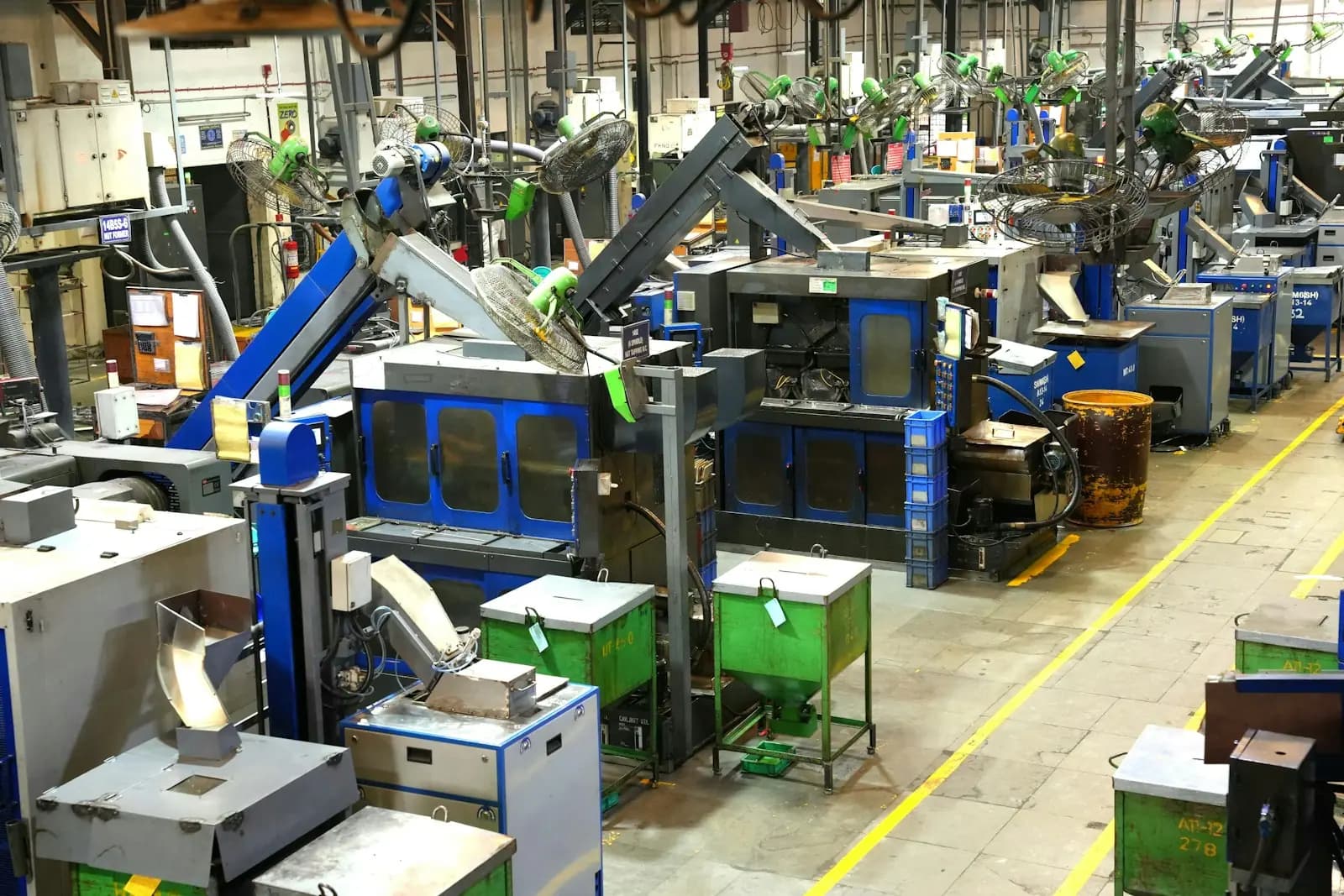
Many owners have one pot of capital and three wants at once: new machinery to produce more, more people in sales or operations, and a second branch. Each proposal sounds reasonable, and someone usually brings a handsome set of numbers. The question to ask first is whether those numbers still look good if sales come in below plan, and how cheaply you can back out if you have to.
This guide compares the three options with methods an owner can use alone: payback period, NPV, IRR and sensitivity testing. It then ties each option to the legal commitments that come with it: a branch lease, hire-purchase of machinery, and employment. The focus is on choosing what to invest in first. Preparing once you have chosen is covered in the specialised guides listed at the end.
The core answer
No option wins every time. Choose using three tests together. First, how much money comes back, and when, after allowing for the time value of money (NPV and IRR). Second, does the project survive if the assumptions are wrong (sensitivity testing). Third, how easy is it to back out, meaning how long contracts and sunk money tie you in.
As a rule of thumb, the option that needs less money and is easier to reverse is usually worth trying first. The option that needs more money and long contracts should wait until the first has shown that demand is real. That is a way of thinking, not a fixed answer. A business whose machine is the real bottleneck may gain most from machinery first; one that already has sales but lacks people may gain most from the team first.
Every figure labelled "hypothetical example" in this guide only illustrates the method. Use your own real numbers, and take the tax effects of each option to your accountant or tax adviser.
1. What do you need to know before comparing the three options?
Options cannot be compared until each has the same set of numbers. Put the following for every option into one table.
| Item | Meaning |
|---|---|
| Initial investment | Every baht paid before money starts coming back, including deposits, fit-out, opening stock and training |
| Incremental annual cash inflow | Revenue that is genuinely new because of this investment, not the whole company's sales |
| Incremental annual costs | Costs caused by the investment, such as salaries, rent, electricity and maintenance |
| Ramp-up period | Months when costs have started but revenue is not yet at full level |
| Value recovered at the end | Resale value of machinery, returned deposits, remaining stock |
| Commitments payable even if sales do not come | Hire-purchase instalments, rent, fixed salaries |
| Peak cash you must hold in reserve | The point where cumulative cash is lowest, before the project starts paying back |
The most important rule is to count incremental cash only. If customers move from your existing shop to the new branch, the moved sales are not new revenue. If a machine only adds sales when there are extra customers, count only the revenue backed by real orders. For how to keep branch numbers separate, see branch and department profit reporting.
First check what problem you are actually solving. If sales are fine but cash is short, read profitable but short of cash first, because new investment may make cash tighter.
2. What is the payback period, and what are its limits?
The payback period is the time it takes for cumulative cash from the project to equal the investment. For example, investing 600,000 baht and receiving net cash of 300,000 baht a year pays back in 2 years.
Strengths: easy to understand, quick to compute, and a rough indicator of liquidity risk. The faster the money returns, the less exposed you are to things you cannot forecast.
Two limits mean it cannot decide alone.
- It ignores timing. 300,000 baht received in year one is worth more than 300,000 baht in year three, because year-one money can be reinvested or used to repay debt sooner. Payback treats the two the same.
- It ignores cash after the payback point. A project that pays back fast but then stops earning can be worse than one that pays back more slowly and keeps earning.
Hypothetical example: projects X and Y both cost 900,000 baht and both pay back in 3 years.
| Year | X (baht) | Y (baht) |
|---|---|---|
| 1 | 300,000 | 100,000 |
| 2 | 300,000 | 300,000 |
| 3 | 300,000 | 500,000 |
| 4 | 0 | 500,000 |
| 5 | 0 | 500,000 |
Payback says the two are equal, yet over 5 years Y returns 1,000,000 baht more than X, while X pays more in year one. Choosing needs both views, which is why NPV comes next.
Use payback as a screening rule, for instance "reject anything that pays back in more than 4 years", then rank the survivors by NPV.
3. What are NPV and IRR? An explanation for business owners
Time value of money. Money today is worth more than money later because today's money can be reinvested or used to cut interest-bearing debt. NPV therefore discounts each year's cash back to today's value, then subtracts the investment.
The discount rate is the minimum annual return the owner wants from this money, or, put most simply, the cost of money. Build it from two parts: what the same money would earn elsewhere or save by repaying debt, plus a margin for risk, because real projects usually miss their plans. Hypothetical example: if a loan costs 8% a year and the owner wants a further 4% for risk, the discount rate is 12% a year. There is no single right number for every business. Set it yourself and use the same rate for every option so they can be compared.
Reading NPV
- Positive NPV: the project earns more than the return you set, and the excess is value added in today's money.
- Negative NPV: it earns less than you require, so you lose value even if the accounts show a profit.
- When capital is limited, also compare NPV per baht invested (the profitability index), because an option with a high NPV that uses all your money can lose to two smaller options done together.
IRR is the annual return that makes NPV exactly zero. If IRR is above the discount rate, the project passes. The caution is that a very high IRR can come from a small project with little money in it, which creates less total value than a larger project with a lower IRR. So use NPV as the main measure and IRR as a supporting one.
Spreadsheets have NPV and IRR functions. Note that a spreadsheet's NPV function usually leaves out the amount paid today, so you must subtract it yourself.
4. What does a hypothetical example comparing machinery, a team and a branch look like?
Suppose the owner has 3,000,000 baht to invest, a discount rate of 12% a year, a five-year horizon, year-end cash flows and no tax. All figures are hypothetical examples, in thousand baht.
| Option | What is invested | Initial investment | Net incremental cash, years 1 to 5 | Value recovered in year 5 |
|---|---|---|---|---|
| A Machinery | New machine to produce more | 2,400 | 700 / 900 / 900 / 900 / 900 | Resale 300 |
| B Add a team | Several posts plus equipment | 600 | 100 / 450 / 600 / 600 / 600 | 0 |
| C New branch | Fit-out, deposit, stock, opening costs | 3,000 | -200 / 700 / 1,200 / 1,200 / 1,200 | Deposit and stock back 900 |
Net cash per year is incremental revenue less all incremental costs. For example, option B has incremental revenue of 1,700 in year 3 and incremental costs of 1,100, leaving 600. Option C loses 200 in year 1 because the branch has not yet reached break-even.
Results (rounded)
| Measure | A Machinery | B Add a team | C New branch |
|---|---|---|---|
| Payback period | about 2.9 years | about 2.1 years | about 4.1 years |
| NPV at 12% (thousand baht) | about +836 | about +997 | about +188 |
| IRR | about 24% | about 54% | about 14% |
| NPV per baht invested | about 0.35 | about 1.66 | about 0.06 |
| Lowest cumulative cash you must hold (thousand baht) | 2,400 | 600 | 3,200 |
How to read it. The branch passes only narrowly: its IRR is just above the discount rate and it takes longest. The team gives the most per baht invested, but that depends on the team actually generating the revenue. Machinery sits in the middle. Because capital is capped at 3,000 thousand, doing A and B together (3,000 in total) gives a combined NPV of about 1,833 thousand, against about 188 thousand for C alone. That combination holds only if the two options do not take revenue from each other. If the new team must sell what the machine produces, build a joint forecast instead of adding the two.
These attractive numbers have not yet passed the key test: what happens when the assumptions are wrong. That is the next section.
5. How do you test sensitivity if sales fall, the start is late or costs rise?
Future numbers will be wrong. The question is whether the project survives being wrong. The simplest method is to change one assumption at a time and recompute NPV, then change all three together.
Using the same hypothetical example, the three scenarios are incremental sales down 20%, cash starting 3 months later than planned, and incremental costs up 10%. (The year-5 recovery value is left unchanged, and the delay case does not add the costs incurred while waiting, so it is gentler than reality.) Figures in thousand baht.
| Scenario | A NPV | B NPV | C NPV | C payback |
|---|---|---|---|---|
| As planned | +836 | +997 | +188 | about 4.1 years |
| Sales down 20% | -480 | -54 | -3,181 | none within 5 years |
| 3-month delay | +746 | +952 | +99 | about 4.3 years |
| Costs up 10% | +484 | +631 | -1,229 | about 5 years |
| All three together | -876 | -425 | -4,553 | none |
Observations
- A fall in sales hurts most in all three options, because fixed costs do not fall with it. A branch with high rent and fixed salaries suffers the most.
- The branch is the most sensitive. NPV swings from slightly positive to minus several million baht when sales fall by only one fifth.
- Machinery and the team hold up better against a late start or higher costs, but both turn negative if sales fall, and when all three things happen together.
- A 3-month delay looks milder in the table than in practice. In real life the owner carries rent, instalments and salaries while waiting, so cash is tighter than the table shows.
How to use the result. Ask "if the worst case I can tolerate happens, can I still pay the fixed commitments?" rather than "how good do the numbers look?" If an option fails after a small miss in sales, shrink it: a smaller branch, a trial with a small team, or rent before buying. Then test again.
Base sales assumptions on evidence such as quotations, existing orders or real customer data, not guesses, and link them to your budget as in first company budget: sales, expenses and cash.
6. Which option is hardest to back out of, and where does the money get stuck?
Irreversibility is the part of the money you cannot get back if you change your mind. The harder an option is to reverse, the higher the bar it should clear, because a mistake costs more.
| Issue | Machinery | Add a team | Open a branch |
|---|---|---|---|
| Money certain to be sunk | Gap between purchase price and resale price; specialised machines can be hard to sell | Recruitment, training, time before full output | Fit-out and fixtures that cannot be moved, opening costs |
| Continuing commitments | Hire-purchase instalments, maintenance | Fixed salaries, and severance if let go later | Rent for the whole term, branch payroll |
| Can you reduce by scaling down? | Resell or return to the hire-purchase owner if the contract allows | Yes, one post at a time, but employee rights must be counted | Much harder: you close the whole branch and negotiate an exit from the lease |
| Tied to whom | Supplier, bank or hire-purchase company | Employees under labour law | Landlord, staff, fit-out contractor |
| Difficulty of backing out (general) | Medium | Low to medium | High |
The ratings in the last row are general observations, not rules. A custom-built machine may be harder to exit than a short-lease branch, and a long-serving team has a high exit cost.
The key idea: do the hard-to-reverse option later, after the easier ones have proved the market, or do it in stages: a short-term or pop-up lease first, rent equipment before buying, or hire on a suitable employment contract with a clear review point. If you are choosing between your own branches, franchising and dealers, see expanding with own branches, franchise or dealers.
7. What legal commitments come with buying machinery on hire-purchase?
If you do not buy with cash, the seller or a finance company will often offer hire-purchase. Under the Civil and Commercial Code, hire-purchase is a contract in which the owner lets property out and promises to sell it, or to have ownership pass to the hirer, on condition that the hirer pays a number of instalments.
Points checked against the statute
- It must be in writing. A hire-purchase contract not made in writing is void (Civil and Commercial Code section 572).
- The hirer may end it at any time by returning the property to the owner at the hirer's own cost (section 573). Whether sums already paid come back depends on the contract.
- The owner may terminate if the hirer misses two consecutive instalments or commits a material breach, and sums already paid may be forfeited with the owner retaking the property (section 574). The final instalment carries an additional period condition, so read the statute alongside your contract.
What to read in the actual contract. Beyond what the law sets, contracts add many terms, and several affect the investment decision.
- Total instalments and interest compared with the cash price, and the down payment
- Penalties and costs on default, including the right to repossess the machine
- Who bears the risk of damage or loss, and whether insurance is required
- Guarantors: if a director guarantees personally, a signed written document is needed (Civil and Commercial Code section 680), which puts the director's personal assets at risk
- Terms on moving, modifying and maintaining the machine
- Acceptance conditions if the machine does not meet specification, see machinery that does not meet specification
Imported machinery adds customs, tax and licensing issues, see importing machinery for a new factory. If the machine goes into a factory, check against factory operating licence that machine capacity and business type remain within what the licence allows.
Remember: hire-purchase instalments are a fixed commitment payable even when sales do not come, and a bank will count them when assessing your other credit. Include them in your sensitivity test.
8. What liability arises if you hire a team and have to reduce it later?
Hiring looks more flexible than buying a machine or renting a branch, but if you later decide to reduce headcount, severance must be paid. Include that cost in the assessment before you hire.
Section 118 of the Labour Protection Act B.E. 2541 (1998) requires the employer to pay severance to an employee who is dismissed, according to continuous length of service, at no less than the following number of days of the last wage (checked against the text published by the Department of Labour Protection and Welfare).
| Continuous service | Minimum severance (days of last wage) |
|---|---|
| 120 days but under 1 year | 30 days |
| 1 year but under 3 years | 90 days |
| 3 years but under 6 years | 180 days |
| 6 years but under 10 years | 240 days |
| 10 years but under 20 years | 300 days |
| 20 years or more | 400 days |
The employer need not pay severance where the employee's conduct falls within section 119, such as dishonesty in the duty or intentional damage to the employer. But cutting jobs because the business is weak or being restructured is not automatically an exception; it depends on the facts of each case. For employees' other rights, see severance pay when dismissed.
Hypothetical example: an employee on a 25,000 baht wage who has worked 3 years but under 6 years is entitled to at least 180 days, about 6 times the monthly wage, or roughly 150,000 baht per person. If the new team has 4 people and all are let go after 3 years, the liability is about 600,000 baht, equal to the whole initial investment of option B in the example above. This does not include other damages or benefits agreed in the contract.
Ways to reduce the risk. Hire one post at a time against measured workload (see before hiring more staff), write clear employment contracts and review dates, and do not rely on a probation period as a way to dismiss without severance, because section 118 counts from 120 days of work.
9. What do a branch lease and licences commit you to?
The lease. Under section 537 of the Civil and Commercial Code, hire of property is a contract in which the lessor lets the lessee use or benefit from property for a limited period and the lessee pays rent. For immovable property the form rules matter.
- Without written evidence signed by the party to be held liable, the lease cannot be enforced in court (section 538)
- If the term is longer than three years, or for the life of the lessee or lessor, it must be in writing and registered with the competent officer, otherwise it is enforceable only for three years (section 538)
A tenant who spends millions on fit-out should get any lease over three years registered. Without registration, enforceability is limited to three years, which may be shorter than the branch's payback period (about 4 years in the example above).
Points to negotiate in a branch lease, matched to the risks seen in the sensitivity test
- Lease term, renewal rights, and a right to end early if sales fall short
- When and by how much rent rises; any initial period without rent (if offered) written into the contract
- Deposit, conditions for its return, and guarantors
- Who owns the fit-out at the end and whether you must restore the premises
- If the landlord sells the property, a lease of immovable property does not end on transfer of ownership; the transferee takes the transferor's rights and duties (section 569), but you should still have complete written evidence
For a factory or production building, see ready-built factory lease.
Licences and registrations. A branch may need further registrations and licences depending on the business type and location, such as branch registration with the relevant agency, a licence for the type of business, signage and local rules. Check these before signing the lease, because rent starts running but you cannot open if the licence is refused. The full readiness list is in before opening a second branch, and contract and employee-document control across branches is in multi-branch contracts and employee documents.
10. Where do business owners most often go wrong in this decision?
- Looking only at payback, ignoring whether money keeps coming in afterwards
- Using the seller's or landlord's best-case numbers instead of numbers you checked yourself; whoever is selling has a reason to make them look good
- Counting total sales instead of incremental cash, so a new branch takes customers from the old one unnoticed
- Forgetting working capital. After investing you still need money for stock, receivables and the ramp-up
- Not testing the bad case, and not setting an exit trigger in advance, such as what to do if the first three months of sales fall below a threshold
- Signing before reading. Hire-purchase, lease and employment contracts contain terms that fix the cost of backing out in advance
- Funding a long-term project with short-term debt that falls due before the project pays back
- Making a plan and not tracking it. Turn it into an action plan with weekly indicators, see from business plan to a 90-day execution plan
11. What should you check before investing?
- Put the initial investment, incremental cash and ramp-up of every option into one table
- Set the discount rate from your required return and use the same rate for every option
- Compute payback period, NPV, IRR and NPV per baht invested
- Test sales down 20%, a 3-month delay and costs up 10%, one at a time and together
- Work out the lowest cumulative cash you must hold, and keep a reserve for the bad case
- Say which option is hard to reverse and set an exit trigger in advance
- Hire-purchase: read the contract, confirm it is in writing, and check guarantors, termination, forfeiture and acceptance terms
- Hiring: work out severance under section 118 if you reduce staff later, and write clear employment contracts
- Branch lease: check form, term, registration if over three years, deposit, fit-out and early-exit rights
- Check the licences needed before opening, before committing by signature
- Ask your accountant about the tax of each option, and have a lawyer review the contracts before signing
Further reading
- Before opening a second branch — readiness checklist once you have chosen the branch
- Before hiring more staff — measuring workload and the total cost of a position
- Importing machinery for a new factory — customs, tax and licences when the machine comes from abroad
- First company budget: sales, expenses and cash — setting a budget so you know how much you can invest
- Profitable but short of cash — working capital before investing more
- Branch and department profit reporting — measuring after the investment whether the branch or department really pays
- From business plan to a 90-day execution plan — acting once you have decided
Choose by incremental cash, not total sales. Screen with payback, decide with NPV and IRR, test the bad case, and read the lease, hire-purchase and employment contracts before signing, because legal commitments are part of the cost of backing out.
We help review and draft leases, hire-purchase agreements and employment documents, and prepare business plans and the figures behind investment decisions for businesses in Thailand. For an initial consultation, call +66 92 254 2045 or send us the details. See also our contracts and documents, business plan and accounting and tax services.
This guide is published by Suwanvara Law Firm — a Khon Kaen law firm established in 1986. General information only, not legal advice on a specific matter.
